French-led forces retake key north Mali town


BAMAKO: French-led troops recaptured the Islamist stronghold of Gao on Saturday, in a major boost to their 16-day-old offensive against Al Qaeda-linked rebels holding Mali's vast desert north.

France's Prime Minister Jean-Marc Ayrault said the nation's troops were also advancing on Timbuktu, another key northern town held by the insurgents.

The seizure of Gao, the most populated town in Mali's northern region, which is roughly the size of Texas, was announced by the French defence ministry and confirmed by Malian security sources.

France said troops from Niger and Chad "will pick up the baton" and that the mayor of Gao, Sadou Diallo, was due to return from the capital Bamako, 1,200 kilometres (750 miles) to the southwest.

"A first contingent of Malian, Chadian and Niger troops are presently in Gao to help secure it," a Malian security source told AFP by telephone from the town. They had been flown in from Niamey, capital of neighbouring Niger.

"The French and African forces are in 100-percent control of the town of Gao," another Malian security source said. "There is popular rejoicing and everyone is very happy."

Other soldiers from Chad and Niger meanwhile were moving toward the Malian border from the Niger town of Ouallam, which lies about 100 kilometres southeast of Gao.

French-led forces had overnight Friday seized Gao's airport and a key bridge on the southern entrance of the town, held by the Al Qaeda-linked Movement for Oneness and Jihad in West Africa (MUJAO).

There had not been substantive fighting around Gao, said a spokesman for the French military command, but there was some sporadic gunfire from "terrorist elements".

Defence ministry sources in Paris described as "plausible" a report in the Le Monde, citing military sources, that hundreds of Islamists had died since the French military intervention in Mali.

In April last year after a coup in Bamako, an alliance of Tuareg rebels who wanted to declare an independent homeland in the north and several hardline Islamist groups seized Gao, Timbuktu and Kidal.

The Islamists quickly sidelined the Tuaregs and imposed their harsh interpretation of Islamic sharia law. Transgressors were flogged, stoned and executed, they banned music and television and forced women to wear veils.

The Islamist groups include Al-Qaeda in the Islamic Maghreb (AQIM); the MUJAO, which is an offshoot of AQIM; and homegrown Islamist group, Ansar Dine.

French Prime Minister Jean-Marc Ayrault said the troops were currently "around Gao and (will be) soon near Timbuktu," further to the west. A fabled caravan town on the edge of the Sahara desert, for centuries it was a centre of Islamic learning.

"The objective is that the African multinational force being put together be able to take over, and that Mali be able to begin a process of political stabilisation," he said.

The MUJAO meanwhile said it was ready for negotiations to release Gilberto Rodriguez Leal, a French national of Portuguese origin kidnapped in western Mali in November.

But Ayrault snubbed the offer. "We will not give in to blackmail," he said.

"We cannot cede to terrorism because if this is the case they will win every time."

West African defence chiefs meanwhile reviewed the slow deployment of regional forces to bolster the French-led offensive at an emergency meeting in Ivory Coast boosting their troops pledges to 5,700 from the previous 4,500.

Chad, which neighbours Mali but is not a member of the Economic Community of West African States raising that force, has separately promised 2,000 soldiers.

A fraction of the African forces has arrived in Bamako, the Malian capital in the south of the country, and is slowly deploying elsewhere. So far however, the French and Malian forces have done all the fighting.

France has already deployed 2,500 troops to Mali and its defence ministry says 1,900 African soldiers are already on the ground there and in Niger.

Aid agencies have expressed concern about the growing food crisis for civilians in the vast semi-arid north of Mali and the drought-stricken Sahel as a whole.

- AFP/fa


Read More..

Pentagon steps up assistance to French in Mali


Mali military battles Islamist insurgents


Mali military battles Islamist insurgents


Mali military battles Islamist insurgents


Mali military battles Islamist insurgents


Mali military battles Islamist insurgents


Mali military battles Islamist insurgents


Mali military battles Islamist insurgents


Mali military battles Islamist insurgents


Mali military battles Islamist insurgents


Mali military battles Islamist insurgents


Mali military battles Islamist insurgents


Mali military battles Islamist insurgents


Mali military battles Islamist insurgents


Mali military battles Islamist insurgents


Mali military battles Islamist insurgents


Mali military battles Islamist insurgents


Mali military battles Islamist insurgents


Mali military battles Islamist insurgents


Mali military battles Islamist insurgents


Mali military battles Islamist insurgents


Mali military battles Islamist insurgents


Mali military battles Islamist insurgents


Mali military battles Islamist insurgents


Mali military battles Islamist insurgents


Mali military battles Islamist insurgents


Mali military battles Islamist insurgents


Mali military battles Islamist insurgents


Mali military battles Islamist insurgents


Mali military battles Islamist insurgents


Mali military battles Islamist insurgents


Mali military battles Islamist insurgents


Mali military battles Islamist insurgents


Mali military battles Islamist insurgents


Mali military battles Islamist insurgents


Mali military battles Islamist insurgents


Mali military battles Islamist insurgents


Mali military battles Islamist insurgents


Mali military battles Islamist insurgents


Mali military battles Islamist insurgents


Mali military battles Islamist insurgents


Mali military battles Islamist insurgents


Mali military battles Islamist insurgents


Mali military battles Islamist insurgents


Mali military battles Islamist insurgents


Mali military battles Islamist insurgents


Mali military battles Islamist insurgents


Mali military battles Islamist insurgents


Mali military battles Islamist insurgents


Mali military battles Islamist insurgents


Mali military battles Islamist insurgents


Mali military battles Islamist insurgents


Mali military battles Islamist insurgents


<<


<


1


2


3


4


5


6


7


8


9


10


11


12


13


14


15


16


17


18


19


20


21


22


23


24


25


26


27


28


29


30


31


32


33


34


35


36


37


38


39


40


41


42


43


44


45


46


47


48


49


50


51


52


>


>>


STORY HIGHLIGHTS


  • NEW: United States agrees to conduct aerial refueling missions, to transport troops

  • Malian and French forces recapture the city of Gao, a stronghold of the Islamic militants

  • The Malian offensive is backed by French forces


(CNN) -- The United States is intensifying its involvement in Mali, where local and French forces are battling Islamic militants.


It will support the French military by conducting aerial refueling missions, according to the Pentagon, which released a short statement Saturday following a call between Defense Secretary Leon Panetta and French Defense Minister Jean-Yves Le Drian.


"The leaders also discussed plans for the United States to transport troops from African nations, including Chad and Togo, to support the international effort in Mali. Secretary Panetta and Minister Le Drian resolved to remain in close contact as aggressive operations against terrorist networks in Mali are ongoing," it read.


U.S. policy prohibits direct military aid to Mali because the fledgling government is the result of a coup. No support can go to the Malian military directly until leaders are chosen through an election.


But the United States is supporting the effort with intelligence and airlift support.


So far, the U.S. Air Force has flown at least seven C-17 cargo missions into Mali, carrying 200 passengers, mainly French troops, and 168 tons of equipment, according to Maj. Robert Firman, a Pentagon spokesman.


The uptick in U.S. involvement comes as Malian forces loosened the grip that Islamist militants' hold in the country's north with the retaking of the city of Gao.


With the support of French forces, the Malians entered and took control of Gao, which for months had been a militant stronghold, the French defense ministry said.


The advance was made in stages, with forces taking Gao's airport and the main bridge leading to town before entering the rest of the city.


"Jihadist terrorists, who have fought Malian and French armies, have seen their mobile and logistical capabilities reduced," the ministry said in a news release.


The quickening advance of the government forces has brought them to the heart of the territory held by the militants.


Broken limbs, torn lives in northern Mali


The Islamic extremists carved out a large haven in northern Mali last year, taking advantage of a chaotic situation after a military coup by the separatist party MNLA. The militants banned music, smoking, drinking and watching sports on television. They also destroyed historic tombs and shrines.


The takeover stoked fear among global security experts that Mali could become a new hub for terrorism.


Refugees tell harrowing stories of life under the Islamist militants.


But the French-based International Federation for Human Rights said it is "very alarmed" by reports that Malian soldiers are themselves carrying out extrajudicial killings and abuses as they counterstrike.


The United Nations' refugee agency, UNHCR, has called for an increase in international aid for the hundreds of thousands of people who have been displaced by the fighting in the country.


More signs al Qaeda in Mali orchestrated Algeria attack


More than 150,000 refugees have fled Mali into neighboring countries, and another 230,000 are displaced inside Mali, the agency said.


The military's advance into Gao may shed more light on the conditions that residents there have faced. According to the U.N. agency, one former resident told of a hospital stripped of medicine by the armed militants and filling with bodies.


As the Malian troops advance, some other countries in the region are joining the French force aiding them. Between 700 and 800 African troops from Benin, Nigeria, Togo and Burkina Faso have arrived, U.S. State Department spokeswoman Victoria Nuland said Friday, and a number of Senegalese troops and up to 2,000 from Chad are on the way.


France has 2,150 soldiers on Malian soil, with 1,000 more troops supporting the operation from elsewhere.


French involvement in the conflict began on January 11, the day after militants said they had seized the city of Konna, east of Diabaly in central Mali, and were poised to advance south toward Bamako, the capital.


Until 1960, Mali had been under French control.


The MNLA, made up of ethnic Tuareg rebels, staged their coup against Mali's central government after returning to Mali well-armed from fighting for late Libyan leader Moammar Gadhafi.


Mali's famed Timbuktu without water, other services


CNN's Pierre Meilhan and Barbara Starr contributed to this report.


Read More..

Chavez begins more medical treatment in Cuba

SANTIAGO, Chile Venezuelan President Hugo Chavez has defeated a respiratory infection and has begun additional medical treatment in Cuba after struggling with complications following cancer surgery more than six weeks ago, a government spokesman said Saturday.

Venezuelan Information Minister Ernesto Villegas said that it remains unclear how soon Chavez could return home, and did not specify the kind of treatment he is receiving.

"Vice President (Nicolas) Maduro estimates that the time it could take President Chavez to return is within weeks. But we haven't wanted to fix an exact timeframe for the president's recuperation," Villegas told reporters on the sidelines of a 60-nation summit in Chile.

He read a statement that went beyond past government reports in providing additional information about Chavez's Dec. 11 surgery, but didn't describe the newest treatment. While refusing to release many details about the president's cancer, authorities in the past have reported on specific treatments, including radiation and chemotherapy.

"Forty-five days after carrying out a complex surgical intervention for the removal of a malignant lesion in the pelvis, with severe, acute complications, the patient's general evolution is favorable," Villegas said, reading the statement.

"At this time, the serious respiratory infection has been overcome, although a certain degree of respiratory deficiency persists and is being duly treated," Villegas said.

After that improvement, Villegas said, "systemic medical treatment for the fundamental illness began to be applied as a complement to the surgery."

Villegas also criticized Spain's leading newspaper El Pais, which was forced to reprint its Thursday edition after discovering that its front-page exclusive photograph supposedly showing an ailing Chavez being treated in Cuba was a fake.

The newspaper apologized to its readers for the mistake and said it was investigating how the photo made its way into the paper.

"But who has apologized to Chavez or his family?" Villegas said.

"In Venezuela we've seen a phenomenon where even the atheists are praying for Chavez," he said. "In Uruguay, President Mujica, who's not a believer, organized a Mass and prayed for Chavez."

Chavez hasn't appeared or spoken publicly since before the operation.

Maduro said early Saturday after meeting with Chavez in Cuba that the ailing president is now "in the best moment we've seen him in these days of struggle" following the surgery.

Maduro spoke on state television after returning from Havana to Venezuela, and before he traveled to Chile for the summit.

"We're taking a message prepared by the president, and we're going to turn it over to heads of state who attend the CELAC summit. He makes fundamental proposals," Maduro said, adding that the message was in Chavez's handwriting.

Maduro said Chavez also sent a message for Venezuelans, including that he was "very optimistic" about his treatment. Maduro said Chavez is "hanging on to Christ and to life."

Chavez has undergone repeated surgeries, chemotherapy and radiation treatment for an unspecified type of pelvic cancer. He has undergone much of his treatment in Cuba.

The 58-year-old president won re-election in October, and lawmakers indefinitely put off his inauguration earlier this month in a decision that was condemned by opponents but upheld by the Supreme Court.

The vice president said that Chavez "has reviewed and evaluated reports on different areas and has made decisions."

He said Chavez evaluated the country's economic situation and budget and made decisions about gold reserves, funding for public housing projects and "social investments and economic development." Maduro didn't give more details but said the actions approved by the president were intended to "guarantee the country's economic growth, infrastructure, housing."

Maduro said that one of the documents signed by Chavez dealt with the selection of his socialist party's candidates for mayoral elections later this year. The vice president showed the signature in red ink on one of the documents.

Read More..

Newtown Families March for Gun Control in DC


Jan 26, 2013 4:59pm


gty gun control march washington jt 130126 wblog Newtown Victims Families Join Gun Control Activists on DC March

(YURI GRIPAS/AFP/Getty Images)


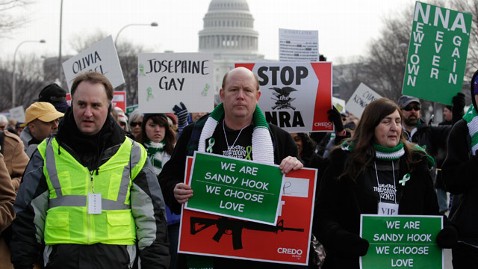
WASHINGTON, D.C. — Near-freezing temperatures didn’t stop several thousand gun-control activists from bearing their pickets today, carrying signs emblazoned with “Ban Assault Weapons Now” and the names of gun violence victims in a demonstration organized as a response to the mass shooting in Newtown, Conn. last month.


Walking in silence, the demonstrators trudged between Capitol Hill and the Washington Monument over a thin layer of melting snow. They were joined by politicians and some families of the Newtown victims.


March organizer Shannon Watts said the event was for the “families who lost the lights of their lives in Newtown, daughters and sons, wives and mothers, grandchildren, sisters and brothers gone in an unfathomable instant.”


“Let’s stand together and use our voices, use our votes to let legislators know that we won’t stand down until they enact common sense gun control laws that will keep our children out of the line of fire,” she told demonstrators.


Watts founded One Million Moms for Gun Control after the killing of 20 first graders and six adults at the Sandy Hook Elementary School in Newtown in December. In a profile with the New York Times, Watts said her 12-year-old son had suffered panic attacks after learning of last summer’s Aurora, Colo., theater shooting, leaving her at an impasse over how to talk to him about the latest tragedy.


Also among the speakers was a survivor of the 2007 Virginia Tech massacre, Collin Goddard.


“We need to challenge any politician who thinks it’s easier to ask an elementary school teacher to stand up to a gunman with an AR-15 than it is to ask them to stand up to a gun lobbyist with a checkbook,” he said.


The demonstration comes amid a push by progressive lawmakers to enact stricter gun control measures as a response to the trend of recent mass killings, although any hypothetical bill would likely face strong opposition in Congress.


Rep. Chris Van Hollen, D-Md., was among the demonstrators today.


“The idea that people need high-capacity magazines that can fire 30, 50, 100 rounds has no place in a civilized society,” he said. “Between the time we’re gathered here right now and this time of day tomorrow, across America, 282 Americans will have been shot.”


The congressman was quoting statistics compiled by the Brady Campaign to Stop Gun Violence.


INFOGRAPHIC: Guns by the Numbers


Last week President Obama proposed a sweeping overhaul of federal measures regulating gun ownership, including a universal background check system for sales, banning assault weapons,  and curbing the amount of ammunition available in weapon clips.


An ABC News/Washington Post poll released Thursday found 53 percent of Americans viewed Obama’s gun control plan favorably, 41 percent unfavorably. The division was visible today, as a handful of gun-rights advocates also turned out on the National Mall to protest what they believe would be infringements on their Second Amendment liberties.


ABC’s Joanne Fuchs contributed to this report.


SHOWS: Good Morning America World News


Read More..

Where is aid for Syria going?


STORY HIGHLIGHTS


  • The U.S. ambassador to Syria says the U.S. has provided $210 million in humanitarian aid

  • The assistance has to be discrete, he said, to protect workers from being targeted

  • Washington has also provided $35 million worth of assistance to Syria's political opposition

  • Ambassador: We can help, but it's up to Syrians to find their way forward


(CNN) -- It has been more than a year since the United States government withdrew its ambassador to Syria and closed its embassy in Damascus.


On Thursday, that ambassador returned to the region along with a U.S. delegation, touring a Syrian refugee camp in Turkey to bring more attention to the growing humanitarian crisis. As the civil war has intensified in Syria, hundreds of thousands of people have sought refuge in Turkey, Lebanon, Jordan and other neighboring countries.


Ambassador Robert Ford gave an exclusive interview to CNN's Ivan Watson and described what the U.S. is doing to help the refugees and the Syrian opposition.


Ivan Watson: The U.S. has given $210 million in aid (to Syria), but I think that there is a perception problem because no one can actually point at what that help is. So people conclude there is no help.


Robert Ford: The assistance is going in. It's things like tents, it's things like blankets, it's things like medical equipment, but it doesn't come in big boxes with an American flag on it because we don't want the people who are delivering it to be targeted by the Syrian regime.


The regime is going after and killing people who are delivering supplies. You see them bombing even bakeries and bread lines. So we're doing that, in part, to be discrete.


The assistance is going in ... but it doesn't come in big boxes with an American flag on it.
Robert Ford, U.S. ambassador to Syria


The needs are gigantic. So even though a great deal of American materials and other countries' materials are arriving, the needs are still greater. And that's why we're going to Kuwait to talk to the United Nations and to talk to other countries about how we can talk together to provide additional assistance.


Watson: The head of the Syrian National Coalition, which the U.S. government has backed, came out with a statement very critical of the international community, saying we need $3 billion if you want us to have any say on events on the ground inside Syria. Where is that money?


Ford: (Sheikh Ahmed) Moaz al-Khatib is a good leader, and we think highly of him and we have recognized his (coalition) as the legitimate representative of the Syrian people. And, of course, he wants to get as many resources as possible because of the humanitarian conditions that I was just talking about. Especially the ones inside Syria.


But we also, at the same time, have to build up those (aid) networks I was talking about. In some cases, they start out with just a few people. We don't need just a few people, we need hundreds of people, thousands of people on the inside of Syria organized to bring these things in.


And so step by step, the Syrians, Moaz al-Khatib and his organization, need to build that capacity. We can help build it, we can do training and things like that. But in the end, Syrians have to take a leadership role in this.


Watson: Is Washington giving money to the Syrian National Coalition?


Ford: We absolutely are assisting the (coalition), with everything from training to, in some cases, limited amount of cash assistance so that they can buy everything ranging from computers to telephones to radios.


Frankly, if not for the American assistance in many cases, the activists inside Syria wouldn't be in contact with the outside world. It's American help that keeps them in contact with the outside world.


Watson: But, how much assistance has this coalition gotten from the U.S.?


Ford: So far, we've allocated directly to the coalition in the neighborhood of $35 million worth of different kinds of equipment and assistance. And over the next few weeks, couple of months, we'll probably provide another $15 million worth of material assistance.


Watson: Washington recently blacklisted Jabhat al-Nusra, the Nusra Front, calling it a terrorist organization even though inside Syria, it has attracted a lot of respect for its victories and for comparative lack of corruption compared to many rebel groups. How has blacklisting the Nusra Front helped the Syrian opposition?


Ford: We blacklisted the Nusra Front because of its intimate links with al Qaeda in Iraq, an organization with whom we have direct experience, which is responsible for the killings of thousands of Iraqis, hundreds of Americans. We know what al Qaeda in Iraq did and is still doing, and we don't want it to start doing that in Syria -- which is why we highlighted its incredibly pernicious role.


I think one of the things that our classification of Nusra as a terrorist group did is it set off an alarm for the other elements of the Free Syrian Army. There was a meeting of the Free Syrian Army to set up a unified command, (and) Nusra Front was not in that meeting -- which we think is the right thing to do. As Syrians themselves understand that Nusra has a sectarian agenda, as they understand better that Nusra is anti-democratic and will seek to impose its very strict interpretation of Islam on Syria -- which historically is a relatively moderate country in terms of its religious practices -- as Syrians understand that better, I think they will more and more reject the Nusra Front itself.


Watson: But I've seen the opposite. As I go into Syria, I hear more and more support and respect for the Nusra Front, and more and more criticism for the U.S. government each time I go back.


Ford: I think that people, Ivan, are still understanding what Nusra is. I have heard criticism from the Nusra Front from people like Moaz al-Khatib who, in Marrakesh (Morocco) in his speech, said he rejected the kind of ideology which backs up Nusra. ... We have heard that from the senior commander of the Free Syrian Army as well. And so the more people understand inside Syria what Nusra is and represents, I think they will agree that is not the group on which to depend for freedom in Syria.


Watson: Do you think the U.S. government could have done more?


Ford: I think the Syrians, as I said, are the ones who will bring the answer to the problem -- just as in Iraq, Iraqis brought the solution to the Iraq crisis, to the Iraq war. The Americans can help, and we helped in Iraq, but ultimately it wasn't the Americans. Despite our help, it was Iraqis.


In Syria, again, it has to be Syrians who find their way forward. Twenty-three million Syrians need to find their way forward. We can help, and we are helping: $210 million in humanitarian assistance, $50 million to help the political opposition get organized for the day after (Bashar) al-Assad goes. These are important bits of help. But ultimately, it's not the American help. It's the Syrians themselves.


Read More..

Apple co-founder says Steve Jobs film inaccurate


LOS ANGELES: Apple co-founder Steve Wozniak said on Friday that a new film about the late Steve Jobs is factually "wrong," while the movie's makers countered it is meant as entertainment -- not a literal retelling of the computer pioneer's life.

Wozniak said the movie "jOBS -- which premiers Friday at the Sundance Film Festival -- erred in its depiction of the characters as well as the relationships between them -- especially the one between him and Jobs.

"We never had such interaction and roles," Wozniak, who quit Apple in 1987 after 12 years, told the tech blog Gizmodo.

"I'm not even sure what it's getting at," he said, adding that the "personalities are very wrong -- although mine is closer."

"The ideas of computers affecting society did not come from Jobs. They inspired me and were widely spoken at the Homebrew Computer Club," he said, referring to a hobby group to which they belonged.

The film, one of two about the iconic Apple founder who died in 2011, is due for release in the United States in April.

"Steve came back from Oregon and came to a club meeting and didn't start talking about this great social impact," said Wozniak, referring to the period in the 1970s before Silicon Valley took off.

"His idea was to make a $20 PC board and sell it for $40 to help people at the club build the computer I'd given away. Steve came from selling surplus parts at HalTed -- he always saw a way to make a quick buck off my designs," said the famously geek-casual-looking Wozniak.

"The lofty talk came much further down the line... I never looked like a professional. We were both kids," he said.

The film's producers responded to Wozniak's comments in a statement cited by Entertainment Weekly.

"The film is not a documentary, nor is it meant to be a blow-by-blow, word-for-word account of all conversations and events," it said.

"The filmmakers have tremendous admiration and respect for Wozniak and all those that are portrayed in the film, and did extensive research in an effort to make an entertaining accurate film that captures the essence and story of Steve Jobs and those that built Apple with him," the statement said.

But the filmmakers acknowledged "that not every single thing in the film is a precise representation of what took place."

The movie "is feature film entertainment about one of the most important, creative and impactful people," their statement added.

Wozniak, who made his criticism after seeing just one short movie clip, conceded that inaccuracies did not necessarily mean the film was bad.

"The movie should be very popular and I hope it's entertaining. It may be very correct, as well. This is only one clip," he said.

"But you'll see the direction they are slanting the movie in, just by the dialogue style of this script," he said.

He added: "Our relationship was so different than what was portrayed. I'm embarrassed. but if the movie is fun and entertaining, all the better. Anyone who reads my book 'iWoz' can get a clearer picture."

- AFP/fa


Read More..

Flu bout lands Burt Reynolds in intensive care


By Carolyn Sung and Greg Botelho, CNN


updated 7:32 PM EST, Fri January 25, 2013


Burt Reynolds through the years


Burt Reynolds through the years


Burt Reynolds through the years


Burt Reynolds through the years


Burt Reynolds through the years


Burt Reynolds through the years


Burt Reynolds through the years


Burt Reynolds through the years


Burt Reynolds through the years


Burt Reynolds through the years


Burt Reynolds through the years


Burt Reynolds through the years


Burt Reynolds through the years


Burt Reynolds through the years


Burt Reynolds through the years


Burt Reynolds through the years


Burt Reynolds through the years


Burt Reynolds through the years


Burt Reynolds through the years


Burt Reynolds through the years


Burt Reynolds through the years


Photos: Burt Reynolds through the years


<<


<


1


2


3


4


5


6


7


8


9


10


11


12


13


14


15


16


17


18


19


20


21


22


>


>>


STORY HIGHLIGHTS


  • Burt Reynolds went to a hospital after developing flu symptoms, his representative says

  • He was dehydrated and moved to intensive care, the representative Erik Kritzer says

  • "He is doing better at this time," Kritzer says Friday afternoon


(CNN) -- Actor Burt Reynolds is in intensive care in a Florida hospital, where he went for treatment of flu symptoms, one of his representatives said Friday.


Reynolds was dehydrated when he went to the hospital, and was eventually transferred to its intensive care unit, his representative Erik Kritzer told CNN.


Kritzer declined to divulge what hospital the actor was in, saying, "He would like that (kept) private."


"He is doing better at this time," Kritzer said late Friday afternoon of the 76-year-old actor. "We expect, as soon as he gets more fluids, he will be back in a regular room."


Born in southern Georgia, Reynolds and his family moved to Michigan and eventually to southeastern Florida, according to his profile on the website of the Florida Artist Hall of Fame, in which he was inducted in 1993. At Palm Beach High School, he first made a name for himself as a football star and earned an athletic scholarship to Florida State University.


When injuries derailed his promising athletic career, Reynolds turned to acting. He scored small parts in the late 1950s, then broke through a few years later in the role of Quint on the TV series "Gunsmoke."


His career took another leap with the 1972 release of "Deliverance," in which he played an Atlanta businessman exploring the remote north Georgia wilderness with friends. "The Longest Yard" came out two years later, starring Reynolds as an ex-football player who lands in prison.


Get the latest update on the flu


These roles earned Reynolds' fame and box office mojo, all while he gained the reputation as a ladies man connected with some of Hollywood's most eligible actresses.


His charismatic notoriety soared through the late 1970s and into the 1980s, during which he spearheaded the "Smokey and the Bandit" and "Cannonball Run" movie franchises. He earned a People's Choice Award in 1979, 1982 and 1983 as all-around male entertainer of the year, and was picked as favorite motion picture actor on that show in 1979, 1980, 1982, 1983 and 1984.


While his popularity waned relatively, Reynolds continued to score movie and TV roles into the 1990s. That included on "Evening Shade," where he earned an Emmy in 1991 playing Wood Newton -- once again, a former football player.


His lone Oscar nomination came in 1998, in the best supporting actor category, for his portrayal of pornographic film producer Jack Horner in the film "Boogie Nights."


Aside from his acting, Reynolds cultivated a prominent public profile through TV commercials, public appearances and more. He also developed a reputation as a philanthropist, especially in his home state of Florida, where he helped found the Burt Reynolds Institute for Film and Threatre.


Read More..

Notre Dame president defends handling of Te'o case

SOUTH BEND, Ind. Top administrators at Notre Dame decided within hours of hearing about the Manti Te'o dead girlfriend hoax that it did not involve a crime and within two days had concluded there was no NCAA violation, according to a letter sent by the university president to board of trustee members on Friday.

The Rev. John Jenkins told trustees that despite "the unrelenting scrutiny of hundreds of journalists and countless others — and repeated attempts by some to create a different impression- no facts relating to the hoax have been at odds with what Manti told us" on Dec. 27-28.

The letter was obtained Friday by The Associated Press from a university official who provided it on condition of anonymity because the private school's internal workings are confidential.

The eight-page document, including a four-page letter from Jenkins and a four-page outline of how Notre Dame handled the hoax, is both a defense and an explanation of the school's actions.

"We did our best to get to the truth in extraordinary circumstances, be good stewards of the interests of the university and its good name and — as we do in all things — to make the well-being of our students one of our very highest priorities," Jenkins concluded in his letter.

Some of the timeline Notre Dame outlined is well known, including that its star linebacker disclosed the scam to his coaches the day after Christmas and it remained unknown to the public until Deadspin.com broke the story on Jan. 16, long after the Fighting Irish lost the BCS championship to Alabama on Jan. 7.

Jenkins wrote that Notre Dame officials talked in the hours after hearing from Te'o on Dec. 26 and agreed there was no indication of a crime or student conduct code violation. Athletic director Jack Swarbrick spoke with Te'o the next day, and on Dec. 28 the school concluded there were no indications of an NCAA rules violation, which could have put Notre Dame's 12-0 regular season in jeopardy.

The school then made moves to find out who was behind the hoax, thereby protecting Te'o and itself.

"For the first couple of days after receiving the news from Manti, there was considerable confusion and we simply did not know what there was to disclose," Jenkins wrote.


13 Photos


Manti Te'o


On Jan. 2, after several days of internal discussion and a week after Te'o's disclosure, Notre Dame retained Stroz Friedberg, a New York computer forensics firm to investigate the case and whether any other football players had been targeted. The firm did not return phone or email messages left Friday.

Notre Dame officials believed Te'o's girlfriend — whether alive or dead — was at least a real person until the next day, when Stroz Friedberg said it could not find any evidence that Kekua or most of her relatives ever existed. And by Jan. 4, two days after hiring Stroz Friedberg, Notre Dame officials concluded Te'o was the victim of the hoax, there was no threat to the school and the private investigation was suspended.

"We concluded that this matter was personal to Manti," Jenkins wrote, deciding it was up to Te'o to disclose, especially after he signed with Creative Artists Agency on the day after the BCS game.


1/2


Read More..

'Hot' Guns Fueling Crime, US Study Says


Christmas is the one day of the year that Wal-Mart is closed, but for a group of four New Mexico burglars, it was the perfect time to stop in for some firearms.


Video surveillance cameras caught the masked burglars red-handed, stealing rifle after rifle. Police arrested the four men, and were able to recover the guns. But all too often, stolen weapons end up in the hands of criminals.


The New Mexico caper is part of a flood of gun thefts nationwide. And it's not only commercial gun dealers vulnerable to theft.


Guns are a top target for home burglars looking for something they can easily sell on the street.


An estimated 230,000 guns per year are stolen in home burglaries and property crimes, according to a study by the Department of Justice.


"Any burglar that goes in a house and finds guns, their eyes are going to light up," says former ATF Assistant Director Mike Bouchard. "That's the first thing they're going to take."


The statistics for commercial thefts show that nearly 25,000 guns per year are lost or stolen from gun dealers.


According to the Bureau of Alcohol Tobacco and Firearms (ATF), more than 4,000 gun stores and retailers have been targeted in the last three years, with 74,000 guns reported stolen or lost. And criminals will use any method possible to get their hands on some weapons, either for their own use, or to sell on the black market.


Minnesota Public Radio, Jeffrey Thompson/AP Photo


Washington Teen Allegedly Helped Steal Father's Guns Watch Video


Obama on Gun Violence Measures: 'This Is Common Sense' Watch Video


Recently, thieves have taken to using a stolen vehicle to ram down the front doors of a gun store. In North Charleston, S.C., for example, burglars smashed a stolen truck right through Guns and Gold Trading Post, stealing $4,500 worth of guns before making a quick getaway.


"Gun stores are like candy stores for criminals," says Mike Bouchard.


2012 was a record year for gun sales, with more than 19.5 million background checks run for gun purchases, up almost 20% from the previous year. But while legitimate sales skyrocket, huge numbers of illegal guns are hitting the streets.


According to the Justice Department, more than 1.4 million guns were stolen or lost between 2005 and 2010.


Former ATF Assistant Director Bouchard says crooks have easy access to cheap stolen guns on the street.


"If you talk to any criminal, they can find a gun within an hour or two. Cheaper guns that were stolen can be sold for $50. On the street, a typical good handgun will run you $200 to $300," Bouchard said.


Some thieves have even targeted gun shipments, stealing the weapons before they get to market.


Last November, for example, a rogue truck driver allegedly stole a shipment of 111 guns he was supposed to deliver from the Smith and Wesson factory in Springfield, Mass.


When police caught him, they recovered 28 of the stolen guns, but some had already been used in crimes.


When police arrested the alleged stick-up robber known as the Black Jacket Bandit, they found one of the stolen guns was allegedly used by him in a convenience store robbery within weeks of the delivery heist.


In November, more than 100 powerful AK-47s were stolen from a rail yard in Atlanta. The guns were in a box car containing more than 1,000 guns being shipped from an overseas manufacturer to a major U.S. distributor, authorities say.


A few of the weapons have been recovered, but police are deeply concerned about having scores of new assault rifles falling into the wrong hands.


Given all the gun thefts, police say it is critical for gun owners to secure their weapons in gun safes or locked cases. And authorities are urging gun retailers to fortify their buildings, to try to prevent "smash and grab" type robberies.


Read More..

Neanderthal cloning? Pure fantasy


A display of a reconstruction of a Neanderthal man and boy at the Museum for Prehistory in Eyzies-de-Tayac, France.


STORY HIGHLIGHTS


  • Arthur Caplan: It would be unethical to try and clone a Neanderthal baby

  • Caplan: Downsides include a good chance of producing a baby that is seriously deformed

  • He says the future belongs to what we can do to genetically engineer and control microbes

  • Caplan: Microbes can make clean fuel, suck up carbon dioxide, clean fat out of arteries


Editor's note: Arthur Caplan is the Drs. William F and Virginia Connolly Mitty professor and director of the Division of Bioethics at New York University Langone Medical Center.


(CNN) -- So now we know -- there won't be a Neanderthal moving into your neighborhood.


Despite a lot of frenzied attention to the intentionally provocative suggestion by a renowned Harvard scientist that new genetic technology makes it possible to splice together a complete set of Neanderthal genes, find an adventurous surrogate mother and use cloning to gin up a Neanderthal baby -- it ain't gonna happen anytime soon.


Nor should it. But there are plenty of other things in the works involving genetic engineering that do merit serious ethical discussion at the national and international levels.


Arthur Caplan

Arthur Caplan


Some thought that the Harvard scientist, George Church, was getting ready to put out an ad seeking volunteer surrogate moms to bear a 35,000-year-old, long-extinct Neanderthal baby. Church had to walk his comments back and note that he was just speculating, not incubating.


Still cloning carries so much mystery and Hollywood glamour thanks to movies such as "Jurassic Park," "The Boys From Brazil" and "Never Let Me Go" that a two-day eruption of the pros and cons of making Neanderthals ensued. That was not necessary. It would be unethical to try and clone a Neanderthal baby.


Why? Because there is no obvious reason to do so. There is no pressing need or remarkable benefit to undertaking such a project. At best it might shed some light on the biology and behavior of a distant ancestor. At worst it would be nothing more than the ultimate reality television show exploitation: An "Octomom"-like surrogate raises a caveman child -- tune in next week to see what her new boyfriend thinks when she tells him that there is a tiny addition in her life and he carries a small club and a tiny piece of flint to sleep with him.


The downsides of trying to clone a Neanderthal include a good chance of killing it, producing a baby that is seriously deformed, producing a baby that lacks immunity to infectious diseases and foods that we have gotten used to, an inability to know what environment to create to permit the child to flourish and a complete lack of understanding of what sort of behavior is "normal" or "appropriate" for such a long-extinct cousin hominid of ours.


When weighed against the risks and the harm that most likely would be done, it would take a mighty big guarantee of benefit to justify this cloning experiment. I am willing to venture that the possible benefit will never, ever reach the point where this list of horrible likely downsides could be overcome.


Even justifying trying to resurrect a woolly mammoth, or a mastodon, or the dodo bird or any other extinct animal gets ethically thorny. How many failures would be acceptable to get one viable mastodon? Where would the animal live? What would we feed it? Who would protect it from poachers, gawkers and treasure hunters? It is not so simple to take a long dead species, make enough of them so they don't die of isolation and lack of social stimulation and then find an environment that is close enough and safe enough compared with that which they once roamed.


In any event the most interesting aspects of genetic engineering do not involve making humans or Neanderthals or mammoths. They involve ginning up microbes to do things that we really need doing such as making clean fuel, sucking up carbon dioxide, cleaning fat out of our arteries, giving us a lot more immunity to nasty bacteria and viruses and helping us make plastics and chemicals more efficiently and cheaply.


In trying to make these kinds of microbes, you can kill all you want without fear of ethical condemnation. And if the new bug does not like the environment in which it has to exist to live well, that will be just too darn bad.


The ethical challenge of this kind of synthetic biology is that it can be used by bad guys for bad purposes. Biological weapons can be ginned up and microbes created that only infect people with certain genes that commonly associate with racial or ethnic groups.


Rather than worry about what will happen to real estate values should a new crop of "Flintstones" move in down the street, our public officials, religious groups and ethicists need to get serious about how much regulation the genetic engineering of microbes needs, how can we detect what terrorists might try to use, what sort of controls do we need to prevent accidents and who is going to pay if a bug turns out to cause more harm than good.


We love to think that the key to tomorrow lies in what humanity can be designed or empowered to do. Thus, the fascination with human cloning. In reality, at least for a long time to come, the future belongs to what we can do to design and control microbes. That is admittedly duller, but it is far better to follow a story that is true than one such as Neanderthal cloning that is pure, speculative fantasy.


Follow @CNNOpinion on Twitter.


Join us at Facebook/CNNOpinion.


The opinions expressed in this commentary are solely those of Arthur Caplan.


Read More..